This page contains links to scanned images of four early texts of Flush (1933), links to some manuscript sources, a table of variants between the British and American editions, with notes on the history of the text.
The four early texts are these, linked to scanned images:
Further details on the book editions:
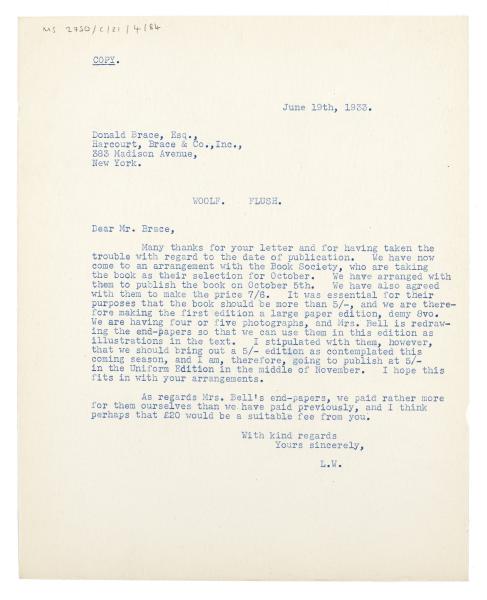
The Hogarth Press "New edition" of Flush (1933), published November 1933 in the Uniform Edition of the Works of Virginia Woolf. This is in fact, except for some pages in the front matter, made up of pages printed for the first impression; these pages were held back when it was decided, in order to conform to the requirements of the Book Society, to charge a higher price for the first edition and to use a larger page size, as Leonard Woolf explained to Donald Brace in a letter of 19 June 1933. The published book included an errata slip, listing corrections already made in the first large-paper impression. Source of the scan: Internet Archive, supplemented with scans of the endpapers.
The Hogarth Press first published edition (but printed from a corrected second impression) of Flush (1933), described in the book as the "First published, October 1933." (A second impression in October 1933 seems to be unchanged.) The book adds three illustrations to the earlier-printed impression described below, and the drawings were redone by Vanessa Bell to be printed as four illustrations, not as two endpaper spreads. Scanned for this site.
The Harcourt, Brace edition of Flush (1933): Source of the scan: Google Books, supplemented with a few improved page imgaes made for this site.
The first published edition is evidently the most authoritative text, but, as described below, the American edition includes a small number of proof revisions that Virginia Woolf either forgot or rejected when correcting proof for the British edition.
Current texts: No edition now in print includes all ten illustrations from the first edition; the only editions that do so are Elizabeth Steele's out-of-print scholarly 1999 Shakespeare Head Press edition (described below) and Alison Light's out-of-print 2000 Penguin Classics edition. A second scholarly edition, in the Cambridge Edition of the Works of Virginia Woolf, is scheduled for publication in July 2026.
The following manuscript sources are in the Berg Collection and may be viewed in scanned images:
A set of uncorrected proofs of the Hogarth Press edition are in the Smith College Library. Scanned images are posted here.
I used an online service called ILovePDF to compare the uncorrected proofs with the earliest printed edition (the "New Edition") and create a PDF that shows the uncorrected proofs with variants from the printed edition highlighted. The corrected readings in the first printed edition may easily be seen by viewing this PDF side-by-side with the scanned image of the "New Edition."
The comparison-PDF may include "false positives" - reported variants that result from errors in reading the scanned images. It should be used with caution, carefully checking its results against the scanned images of the proofs and the "New Edition."
The table below lists verbal variants between the first printed British edition (printed before October 1933, published by the Hogarth Press 16 November 1933) and the first American edition of Flush (published by Harcourt Brace, 5 October 1933).
The first printed edition (UK1) was not the first published edition (UK2). The first printed edition was held back until after a corrected second impression was published in large-paper format, identified on the verso of the title page as “First published, October 1933” and published on 5 October 1933. The first printed edition was trimmed to a smaller size and issued later, in the Uniform Edition of the Works of Virginia Woolf, and described on the verso of its replaced copyright page as “New edition, November 1933”. A errata slip tipped into UK1 lists the corrected dates that had been incorporated into the text of UK2.
The page proofs produced by R. & R. Clark, Edinburgh, are dated 12 through 14 April 1933. Virginia Woolf noted in her diary, 15 April, that she "should be correcting Flush proofs". On 1 May 1933, John Lehmann at the Hogarth Press sent Harcourt Brace two sets of proofs, asking "Will you kindly note that the proof labelled with the name of your firm is the better corrected proof, and the one you should print from." On 29 June 1933, Leonard Woolf sent a telegram to Harcourt Brace correcting the five dates that are also corrected in the Hogarth second impression. This suggests that the first printed edition (which has the erroneous dates) had been printed by the end of June 1933.
One interesting possible conclusion from the table below: The table lists a number of variants in which the Harcourt Brace text matches the Atlantic Monthly text, not the text in the uncorrected proofs sent by John Lehmann on 1 May 1933 to be used as setting copy. This suggests that Harcourt Brace seems to have set its text partly from the Atlantic Monthly version of text, and that it then partly corrected its text to conform to the text of the proofs sent by John Lehmann - but that, in correcting the text, it left some of the Atlantic Monthly readings uncorrected. It is unclear exactly when and how Harcourt would have obtained the Atlantic version.
The table below omits hyphenation and other punctuation variants, and two obvious printer’s errors in the Harcourt edition: “intangibile” for “intangible” and “archfield” for “archfiend”.
The first three columns reflect an electronic comparison of scanned images of the first British printing (UK1) and the first American printing (US).
|
UK pg:ln |
UK1 = first Hogarth printing |
US = first Harcourt, Brace printing |
Notes |
|
9:6 |
Dha laid it down in his |
Dha laid down in his |
UK=p |
|
11:20-21 |
coronet, and then they say you are not only born, but nobly |
coronet, and then you are not only born they say, but nobly |
|
|
13:14 |
no calling cousins with the Mitfords |
no claim to kinship with the Mitfords |
US=p |
|
18:20 |
if one is lucky enough to have one, |
if one is so lucky enough as to have one, |
US=p |
|
19:16 |
No. 50 |
number fifty |
US=p |
|
22:9 |
penurious fries |
penurious frys |
US=p |
|
28:13-14 |
eau-de-Cologne still affected his nostrils disagreeably, when |
eau de cologne still lacerated his nostrils, when |
US=A |
|
30:13 |
he stopped, amazed; defining, savouring, |
he stopped, amazed; smelling, savouring, |
UK=p |
|
33:2-3 |
among dogs: some dogs are high dogs; some are low. |
among dogs: there are high dogs and low dogs. |
|
|
54:8 |
they were hostile, severe. |
they were alien, severe |
UK=p US=A |
|
55:15 |
he felt. Miss Barrett no longer |
he felt. She no longer |
US=A |
|
63:26-64:1 |
break brilliant, blowing red |
break brilliant, glowing red |
UK=p |
|
67:9 |
for ever. Things are not simple |
for ever. But things are not simple |
US=A |
|
71:9 |
the 12th of September |
the 1st of September |
See note 1 |
|
75:1 |
respectability was this squalor. But there |
respectability was this filth. But there |
US=A |
|
75:22 |
their trade all day in the West |
their trade in the West |
UK=p US=A |
|
76:10-11 |
with St. Giles’s were well known. St. Giles’s stole |
with St. Giles’s were laid down. St. Giles’s stole |
UK=P US=A |
|
77:19 |
the 2nd September |
the 1st September |
See note 1 |
|
79:23-24 |
flustered and fluttered its way |
flustered and dashed its way |
US=A |
|
80:23 |
the 3rd September |
the 2nd September |
See note 1 |
|
83:3 |
the 4th of September |
the 3rd of September |
See note 1 |
|
87:7-8 |
why write all this string |
why write this string |
|
|
87:12 |
easy it would have been |
easy it could have been |
(US error?) |
|
89:19-20 |
cows are herded under bedroom floors, where |
cows are herded under the bedroom floor, where |
US=A |
|
90:21-22 |
from the cab. Mr. Taylor had her dog, she said; Mr. Taylor had promised |
from the cab. She said Mr. Taylor had her dog; Mr. Taylor had promised |
US=A |
|
90:24-25 |
Here was the familiar avenue of doors and windows: the pointed brick |
Here were the familiar doors and windows: the avenue of pointed brick |
US~=A (A has “white brick”) |
|
92:5-6 |
later when she sat writing on a sunny |
later when she was sitting on a sunny |
US=A |
|
92:14 |
as they had never chattered to |
as they had chattered to |
US=A,p |
|
93:22 |
sight of the archfiend actually in |
sight of the archfiend Taylor actually in |
US=A,p |
|
94:18-19 |
good humour” he would go |
good humour” that he would go |
|
|
95:21 |
Flush had been at their mercy |
Flush had lain at their mercy |
US=A |
|
96:2 |
only a shelter. It was only a dell |
only a shelter; only a dell |
UK=p |
|
96:15 |
friendly faces was treachery |
friendly faces were treachery |
UK=p |
|
98:17 |
seemed to look at nothing. She drew |
seemed to notice nothing. She drew |
US=p |
|
98:18 |
moment he saw a gold band shine |
a moment he saw a gold ring shine |
|
|
98:23-25 |
for whatever had happened, it was something that must at all costs be concealed |
for whatever had happened, and something had happened, it must at all costs be concealed. |
UK=p |
|
99:20-21 |
nobody else seemed to notice anything. |
But nobody else noticed anything |
US=p |
|
100::1-3 |
leaves in the darkness, in a vast forest; then the leaves were parted and he woke. It was dark; but he saw Wilson |
leaves in a vast forest; then the leaves were parted and he woke. It was dark; but in the darkness he saw Wilson |
US=A |
|
100:6 |
19th of September |
18th of September |
See note 1 |
|
100:19-20 |
more such movements to come to them; but to Miss Barrett |
more such moments to come to them; but for Miss Barrett |
See note 2 |
|
105:7 |
that distinguish Pisa—for it was |
that distinguish Pisa—it was |
US=A |
|
108:5 |
Here in Italy was freedom and life |
Here in Italy were freedom and life |
US=A |
|
114:22 |
Grand Duke was somehow exaggerated |
Grand Duke was exaggerated |
US=A |
|
116:7 |
moved a bed and that she opened |
moved a bed and she opened |
US=A |
|
118:3-5 |
he was left completely alone; nobody came into the drawing-room. He lay |
he was left completely alone. He lay |
US=A |
|
118:18-20 |
both seeing the invisible presence that he felt. Their eyes were oddly glazed. | At last |
both seeing the invisible presence that he felt. | At last |
UK=p |
|
122:4 |
scene that stirred him. Beauty, |
scene that stirred him, not beauty. Beauty |
|
|
122:16-17 |
than two words and one-half for what |
than two words and perhaps one-half for what |
US=p |
|
126:23 |
he heard a man lay |
he heard one man lay |
US=p |
|
128:20 |
perhaps of the Greeks saying |
perhaps of the Greek saying |
|
|
129:17 |
that lesson for himself. But |
that lesson at last. But |
US=A |
|
131:9-10 |
the public-house; they welcomed |
the public-house; and they welcomed |
US=p |
|
134:14-15 |
with one frown he turned |
with one frown, with one stare, he turned |
US=p |
|
146:2 |
droning in the sky |
droning in the air |
US=A |
|
146:25 |
the ecstasies, the innocences |
the ecstasies and innocences |
US=A |
|
149:8-9 |
as he came in. No, it was not a |
as he came in. It was not a |
UK=p |
|
149:16-150:1 |
was very unhappy. Now she was happy. |
was very unhappy. Years had passed; now she was happy. |
UK=p US=A |
|
151:8-9 |
Elizabeth Barrett Barrett |
Elizabeth Barrett Browning |
UK=p |
|
154:20-21 |
it suffers from distortion |
it suffers from the distortion |
UK=p |
|
160:28 |
from a top storey window |
from a top window |
US=p |
|
162:14-15 |
Lytton believed himself |
Lytton thought himself |
US=p |
Note 1: The corrected dates in the US edition also appear in the second UK impression (the first published edition).
Note 2: “movements” is clearly an error, possibly introduced by VW when correcting proof for the British edition, but not when correcting for the American edition; the phrase is not in the uncorrected proofs, and VW would have had to write it into each set of proofs separately.
Note 3: Variant not recorded in Elizabeth Steele’s edition.
Kate Flint's 1998 Oxford World's Classics edition is based on "the first British edition" (apparently the first, uncorrected impression) and lacks the illustrations.
Elizabeth Steele's 1999 Shakespeare Head Press edition is based on the second Hogarth impression, includes all ten illustrations, and has a textual apparatus that records variants among the British and American editions, the Atlantic Monthly text and the proofs.
Alison Light's 2000 Penguin Classics edition is based on the second Hogarth impression and includes all ten illustrations.
Edward Mendelson (edward [dot] mendelson [at] columbia [dot] edu)